
Making Historical Buildings Accessible
Historical or heritage buildings remain an important cultural feature of our country, and exist for our enjoyment and appreciation. Many people assume that due to their protection that if accessibility didn’t exist, it never will.Bespoke Lift Design For Heritage Buildings
Contrary to popular belief, installing accessibility features in historical buildings can actually enhance our understanding of the historic environment and ensure its future sustainability. Historic England fully recognises the challenges providing accessibility for everyone poses, but embraces those challenges with intense debate and rigorous planning. For Historic England, protecting the entire population from discrimination is key to ensuring our historical buildings remain culturally important and significant.
Reasons for Alterations
Historic Buildings were generally not built to accommodate wheelchairs, they have changes of level frequently, and access points can be narrow, high, or twisted. Over time paths can be disrupted, and routes made uneven. These limitations to physical access can be avoided by clever planning of accessibility solutions.
For many historic buildings the problem arises where aesthetic preservation is just as important as future accessibility. Traditional methods of access such as ramps and passenger lifts are not suitable for installation due to the significance of what makes that particular part of the building significant. If a staircase is a significant aesthetic benefit to the building, you cannot for example install a stairlift, as it will affect the significance of the special place. However, at Brothers Lifts we specialise in installing ‘hidden’ accessibility solutions.
Hiding Accessibility in Plain Sight
Special Lifts such as the LP50H (pictured) are able to recess into the floor of any surface and feature the original floor material and pattern on the platform, meaning when not in use, they are able to go undetected by the general public.
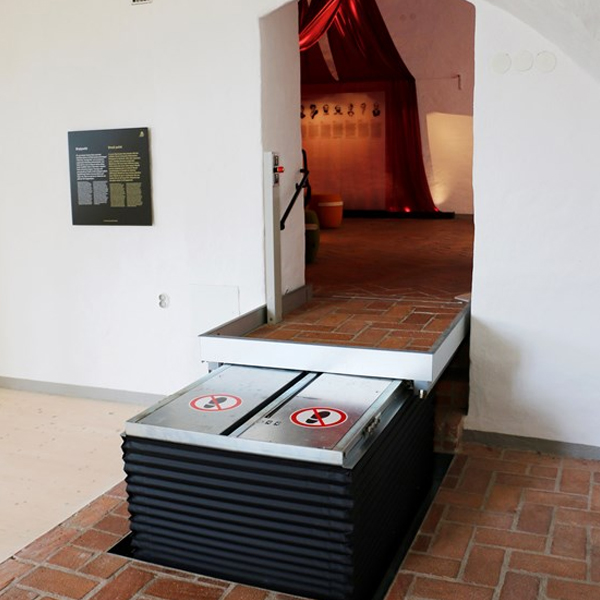
Features of the LP50H include an extremely low depth needed for the pit in which the lift sits. This means that limited alterations need to take place.